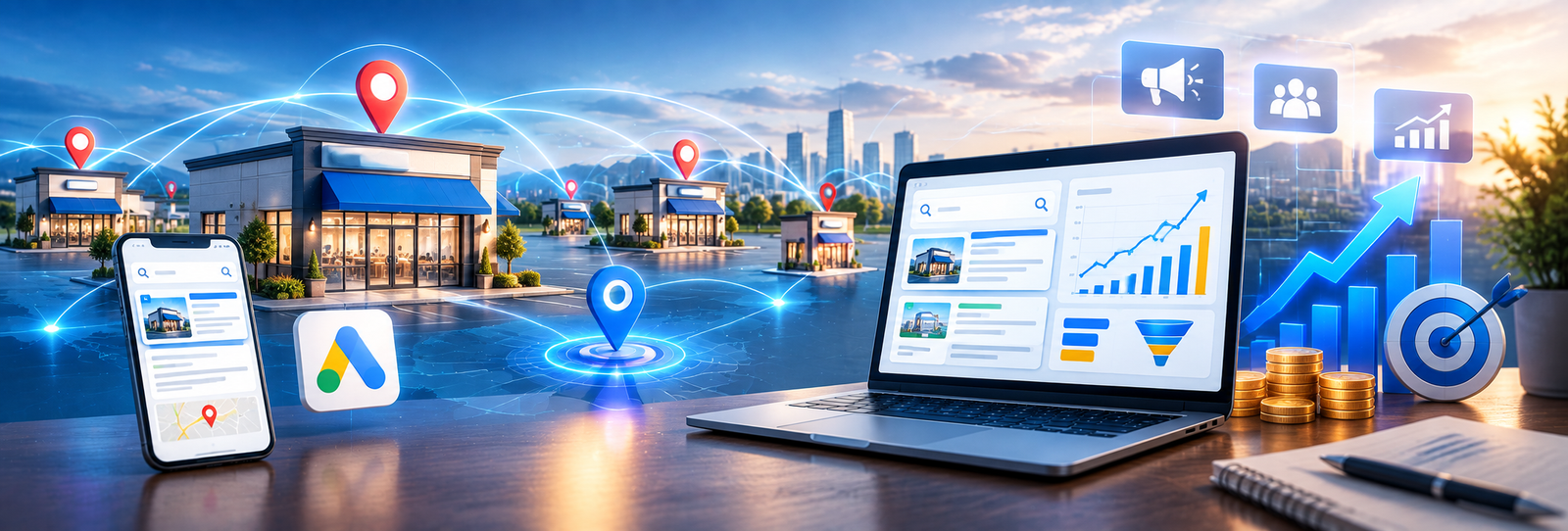
Franchise businesses face a marketing challenge most single-location brands never encounter: balancing brand consistency at the corporate level with hyper-local relevance at the franchisee level. Nowhere is this tension more visible than in Google Ads.
Run PPC the wrong way, and you either waste spend competing against your own franchisees for the same keywords, or you dilute your brand message trying to be “one-size-fits-all” across dozens (or hundreds) of locations. Run it right, and Google Ads becomes one of the fastest, most measurable growth engines a franchise system can have — driving foot traffic, calls, and leads to every location simultaneously.
This guide breaks down exactly how to structure, target, and optimize Google Ads campaigns built specifically for franchise models.
Why Google Ads Matters for Franchise Growth
Franchises operate in a unique space: strong brand recognition nationally, but intense competition locally. Google Ads is uniquely suited to solve this because it allows you to:
- Target hyper-local search intent (“near me” searches, local service queries)
- Scale campaigns across multiple locations without rebuilding from scratch
- Track performance location-by-location, so underperforming franchisees can be identified and supported
- Capture high-intent traffic instantly — unlike SEO, which takes months to build
For franchise brands, PPC isn’t just a lead-gen channel — it’s a franchisee performance visibility tooltoo.
The Core Challenge: Corporate Control vs. Local Relevance
Before diving into tactics, it’s important to understand the central tension in franchise PPC:
| Corporate Priorities | Franchisee Priorities |
|---|---|
| Brand consistency, compliance, unified messaging | Local leads, calls, and store visits |
| National keyword strategy | Local competitor and neighborhood targeting |
| Centralized budget efficiency | Their own location’s ROI |
The best franchise PPC strategies solve this by using a hybrid campaign structure — centralized management with location-level customization.
1. Structure Campaigns by Location, Not Just by Product/Service
Avoid running one giant national campaign for all locations. Instead:
- Create individual campaigns or ad groups per location/region, especially for franchises with 5+ locations
- Use Location Extensions (via linked Google Business Profiles) so ads show the nearest store address, phone number, and directions
- If you have many locations, use Google Ads Location Groups to auto-generate location-specific ads and radius targeting without manual duplication
This ensures someone searching in one city sees an ad relevant to their nearest franchise, not a generic brand message.
2. Use Geo-Targeting and Radius Targeting Strategically
Franchise PPC lives and dies on local targeting precision.
- Set radius targeting (e.g., 5–15 miles) around each physical location depending on service area
- Exclude overlapping radiuses between nearby franchise locations to prevent cannibalization — where two franchisees of the same brand bid against each other
- Layer in “Near Me” and location-modified keywords (e.g., “franchise service + city/neighborhood”)
- Use Local Service Ads (LSAs) alongside Search campaigns for service-based franchises (home services, healthcare, fitness) — they appear above traditional search ads and include verified reviews
3. Build a Centralized Keyword Strategy (With Local Flexibility)
Corporate should own the core keyword architecture, but allow local flexibility:
- Brand keywords: Protect your franchise name from competitor bidding
- Category/service keywords: “book a demo,” “schedule appointment,” “get a quote”
- Local intent keywords: Location + service combinations
- Negative keywords list: Shared across all campaigns to filter irrelevant traffic (e.g., job seekers searching “franchise careers” when the goal is customer acquisition)
Maintaining a shared negative keyword list across the account saves significant wasted spend at scale.
4. Prevent Franchisees From Competing Against Each Other
One of the biggest PPC pitfalls in franchise marketing: multiple franchisees unknowingly bidding on the same keywords in overlapping areas, driving up CPCs for the whole brand.
Fixes:
- Centralize account management under one Google Ads Manager (MCC) account
- Assign clear geographic boundaries per location
- Set bid adjustments by location performance rather than letting every location bid identically
- Use portfolio bid strategies to let Google’s automation balance spend efficiently across locations
5. Customize Landing Pages Per Location
Sending all location traffic to one generic homepage kills conversion rates. Instead:
- Build dedicated location landing pages with local address, phone number, hours, and location-specific offers
- Include local testimonials/reviews if available
- Ensure fast mobile load speed — most local searches happen on mobile devices, often with immediate intent (calls, directions)
- Add clear CTAs: “Call Now,” “Book Appointment,” “Get Directions”
6. Leverage Ad Extensions for Local Impact
Ad extensions dramatically improve franchise ad performance by increasing visibility and click-through rate:
- Location extensions — show nearest store address
- Call extensions — critical for service-based franchises where phone leads convert fast
- Sitelink extensions — link to services, promotions, or location finder pages
- Promotion extensions — highlight local deals or seasonal offers
- Structured snippets — list services, amenities, or brands offered
7. Set Smart Budget Allocation Across Locations
Not every franchise location deserves equal ad spend. Base budget allocation on:
- Historical conversion data per location
- Local market competitiveness (urban markets often have higher CPCs)
- New location “ramp-up” needs (new franchises may need extra visibility investment early on)
- Seasonal demand differences by region
Consider a tiered budget model: high-performing/high-potential locations get more spend, while underperforming locations get optimization support rather than blind budget increases.
8. Track Performance at the Location Level
Franchise PPC success depends on granular reporting, not just account-wide metrics.
Track:
- Cost per lead/call by location
- Conversion rate by location
- Store visit and call tracking (via call extensions and Google’s store visit conversion tracking, where available)
- ROAS or cost-per-acquisition benchmarks per franchisee
This data helps corporate marketing teams identify which locations need creative refreshes, budget changes, or local sales support.
9. Use Automation Wisely — But Don’t Set and Forget
Google’s AI-driven bidding (Target CPA, Maximize Conversions, Performance Max) works well at scale, but franchise accounts need human oversight because:
- Performance Max campaigns can blend budget across locations unevenly if not properly segmented
- Automated bidding needs sufficient conversion volume per location to optimize accurately — smaller locations may need manual bid strategies initially
- Regular audits (monthly/quarterly) prevent budget drift toward already-strong locations at the expense of growing ones
10. Maintain Brand Compliance Across All Campaigns
Since multiple stakeholders often touch franchise PPC (corporate marketing, agencies, sometimes even franchisees themselves), consistency can break down fast.
Best practices:
- Create approved ad copy templates with placeholders for local details
- Maintain brand style guides for creative and messaging
- Use shared ad templates in Google Ads Editor for bulk updates across locations
- Restrict access levels in the Manager account so franchisees can view performance but not alter core campaign structure
Common Mistakes to Avoid
- Running one generic ad for all locations instead of localizing messaging
- Letting franchisees create separate, unmanaged Google Ads accounts
- Ignoring negative keywords, leading to wasted spend on irrelevant clicks
- Sending all traffic to a single homepage instead of location-specific pages
- Failing to track performance by location, masking which franchisees need support
Final Thoughts
Google Ads gives franchise brands a rare advantage: the ability to combine national brand strength with hyper-local precision — driving measurable growth for every location, not just the flagship ones. The key is structure. When corporate maintains centralized control over strategy, keywords, and compliance — while allowing local flexibility in targeting, offers, and landing pages — PPC becomes a scalable growth engine rather than a source of internal competition and wasted spend.
Franchises that treat every location as its own local business within a bigger brand strategy consistently outperform those trying to run PPC with a one-size-fits-all approach.